📑 In this guide
Court Marriage vs Traditional Marriage in India: Process, Cost & Legal Requirements (2026)
Marriage in India is a profound institution, blending emotional, cultural, and legal dimensions. Today, couples have two primary legal avenues to formalize their union: a court marriage under the Special Marriage Act, 1954, and a traditional marriage governed by personal laws like the Hindu Marriage Act, 1955. While both are legally valid, they differ significantly in process, cost, legal requirements, and social implications.
This comprehensive guide will help you navigate these differences and make an informed choice that best suits your personal and legal needs.
What is a Court Marriage?
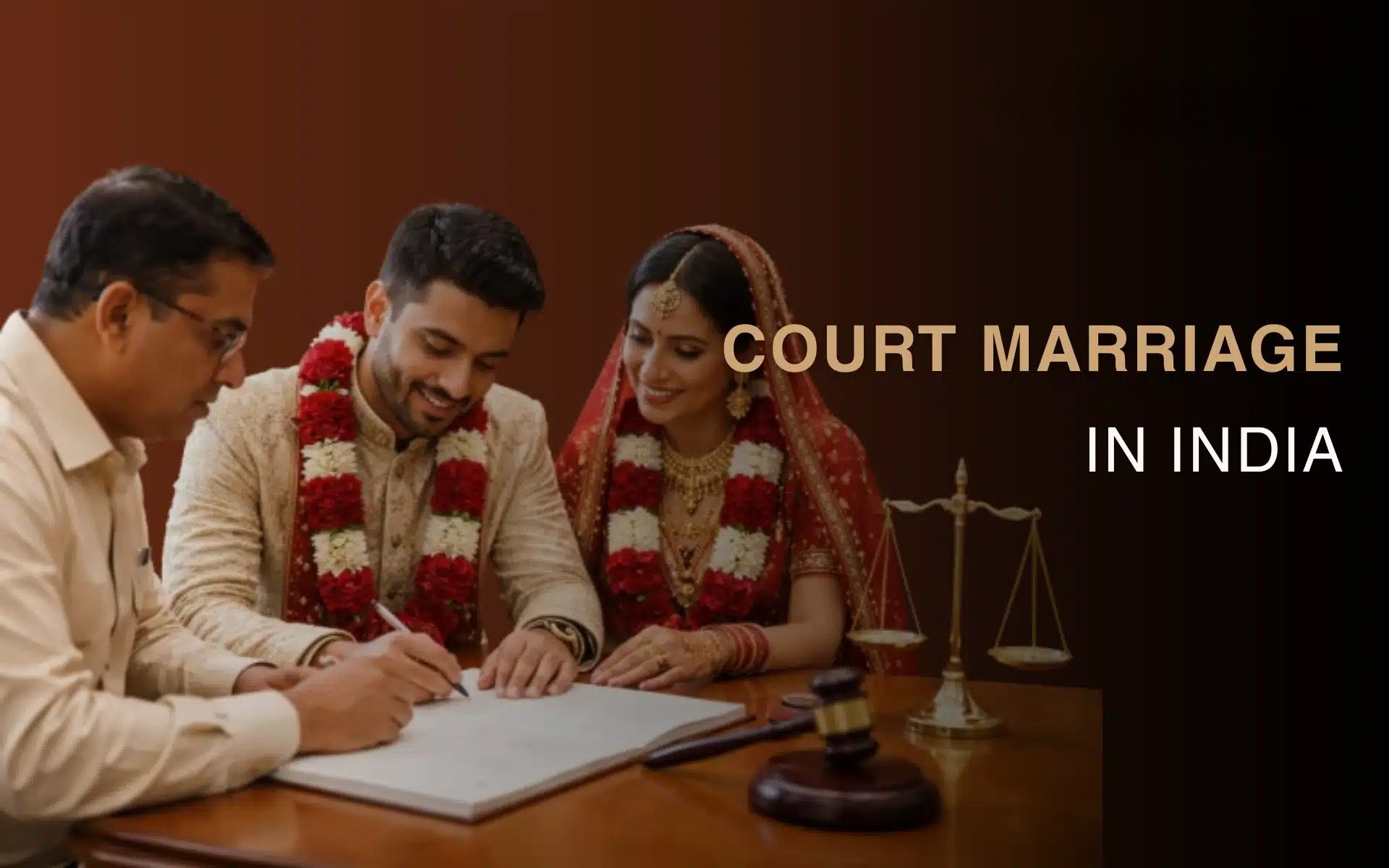
A court marriage is a legally binding civil marriage solemnized and registered under the Special Marriage Act, 1954 . It is a secular process designed for couples who wish to marry without any religious or cultural rituals. The marriage is conducted by a Marriage Officer at a government office (SDM office) in the presence of witnesses.
Key Features of Court Marriage:
Secular and Inclusive: Open to any two individuals irrespective of their religion, caste, or nationality, without requiring conversion .
Simple and Efficient: The process involves a straightforward legal procedure without elaborate ceremonies.
Automatic Legal Proof: The marriage certificate issued is immediate and serves as official proof of the marital union .
What is a Traditional Marriage?
A traditional marriage is performed according to the religious customs and personal laws of the community to which the couple belongs. In India, this is typically governed by laws such as the Hindu Marriage Act, 1955, the Muslim Personal Law (Shariat) Application Act, 1937, or the Indian Christian Marriage Act, 1872 .
Key Features of Traditional Marriage:
Religious and Cultural Significance: It involves rituals like pheras (Hindu), nikah (Muslim), or vows (Christian) that are central to the community's traditions .
Socially Recognized: These ceremonies are often large, celebratory events with deep family and community involvement.
Separate Registration Required: While the ceremony itself may be valid, it must be officially registered with the government to obtain a marriage certificate for legal purposes .
Court Marriage vs Traditional Marriage: Key Differences
To help you compare, here is a detailed breakdown of the differences between the two processes.
1. Governing Law
2. Eligibility Criteria
3. Process and Formalities
4. Cost
5. Legal Rights and Recognition
Which One Should You Choose?
There is no single "right" answer. The choice depends on your personal priorities, family dynamics, and legal needs.
You may prefer a Court Marriage if:
You are from different religions or castes and want a simple, secular union free from religious formalities .
You value legal simplicity, cost-effectiveness, and a straightforward process.
You want immediate, unequivocal legal proof of your marriage for official purposes (passport, visa, property).
You wish to avoid the stress and expense of a large, traditional wedding.
You may prefer a Traditional Marriage if:
You and your family place a high value on cultural and religious customs and want the ceremony to be a significant social event.
You have a strong support system with willing family participation.
You are comfortable with the religious laws governing your marriage and its implications for divorce and inheritance.
A Growing Hybrid Trend: Many modern couples are choosing a hybrid approach . They might have a small, private court marriage for legal security and a simple certificate, followed by a traditional ceremony or reception with family and friends. This balances legal efficiency with cultural celebration.
FAQs
1. Is a court marriage legally valid in India?
Yes, a court marriage under the Special Marriage Act is fully legal, valid, and recognized across India and abroad .
2. Which is cheaper, a court marriage or a traditional marriage?
A court marriage is significantly cheaper, with the government fee being under ₹150. Total costs with legal assistance are typically under ₹20,000. Traditional weddings can cost exponentially more due to the scale of celebrations.
3. Can a court marriage be done in one day?
No, a court marriage under the Special Marriage Act requires a mandatory 30-day notice period, which cannot be waived. After this period, the marriage can be solemnized and the certificate issued .
4. Is it mandatory to register a traditional marriage?
Yes, as per the Supreme Court's directive, registration of all marriages is mandatory in India. A traditional marriage is not considered legally complete for official purposes until it is registered with the government .
5. What is the main difference in the process?
The key difference is the 30-day notice and objection period required for a court marriage, which does not exist for a traditional marriage. Court marriages also do not involve religious ceremonies, focusing purely on the legal declaration .
6. Which marriage is better for inter-faith couples?
A court marriage under the Special Marriage Act is the most straightforward and legal option for inter-faith couples, as it does not require either party to convert to the other's religion .
Conclusion
Both court marriages and traditional marriages are legally binding and protect the rights of the couple. The decision is deeply personal. A court marriage offers simplicity, efficiency, and strong legal clarity, especially for inter-faith couples. A traditional marriage resonates with cultural and familial values but requires a separate, formal registration to become legally complete in the eyes of the state.
If you are planning your marriage, especially in Delhi, and are unsure about the best path, it's wise to seek professional legal advice. Our experienced team at Arora & Arora Associates, with over 30 years of practice at Tis Hazari Courts, can guide you through the process, ensure all legal requirements are met, and help you obtain your marriage certificate smoothly and without hassle.
Need help deciding? Contact us today for a confidential consultation. We provide expert, transparent legal guidance for both court marriages and traditional marriage registratio
![Same-Day Court Marriage in Delhi: Legal Process & Documents [2026]](https://i.ibb.co/nstxf9Rd/14e58fba-1819-4fe8-af7d-58961b443983.webp)